Memento mori: what it means and why skulls became its symbol
Memento mori is a Latin phrase meaning "remember you must die." In art and spiritual practice it's a reminder of mortality and of how briefly earthly things last (Britannica). It was rarely meant to be gloomy. The Stoic philosophers used it to stop putting life off, and medieval and Renaissance Christians used it as a prompt to live well. The skull became its usual symbol, and painters, carvers, jewelers and tattooists have kept coming back to it.
Where does the phrase come from?
The idea is much older than the Latin tag. In Plato's Phaedo, Socrates says that philosophy is practice for dying. The Roman Stoics turned that into everyday advice. Seneca urged his readers to treat each day as a complete life and to settle their accounts with life every day. Marcus Aurelius, writing private notes to himself in the second century, kept returning to how short life is and how soon everyone, emperors included, is forgotten. His Meditations are free to read and still surprisingly practical.
What does memento mori mean in Catholic and Christian tradition?
Christianity took up the same idea with its own emphasis on judgment and the soul. Britannica points to Ash Wednesday, when ashes are placed on the forehead as a reminder of mortality, and to scripture such as Sirach 7:36: "In all you do, remember the end of your life." Saints and theologians wrote meditations on death, and the practice was meant to draw a person closer to God.
It went into buildings too. Inside the Capela dos Ossos, the bone chapel of the old Franciscan convent in Évora, Portugal, the walls, square columns and vaults are lined with bones with hardly a gap, mostly leg bones laid in rows with lines of skulls set between them, so the room feels close to a cave (Discover Baroque Art). The poem at the entrance is the one Britannica translates as "Our bones that are here await yours."
Rome has its own version, under the Capuchin church of Our Lady of the Immaculate Conception on Via Veneto. The friars' museum describes a corridor about thirty meters long with six small rooms off it, holding the remains of around 3,700 people, most of them Capuchin friars (Museo e Cripta dei Cappuccini). Pelvises, vertebrae and shoulder blades are worked into bands, rosettes and eight-pointed stars across the vaults, and one room has a winged hourglass on its back wall. A sign in one of the alcoves, in Smithsonian's translation, reads "What you are now we used to be; what we are now you will be" (Smithsonian Magazine). Out in churchyards the same idea was carved into gravestones as winged skulls, hourglasses and crossed bones.
Why did the skull become the symbol?
Partly because there's no mistaking what it means. During the late medieval period, the full skeleton of the danse macabre, the dance of death that leads popes and peasants alike to the grave, gradually condensed into the skull on its own.
By the early 1600s, Dutch painters had built a whole genre around it. Vanitas still lifes set a skull among books, flowers, watches, soap bubbles and snuffed candles. Jacques de Gheyn II's Vanitas Still Life of 1603, now at the Metropolitan Museum of Art, is often called the earliest independent still life of the type. A skull sits under a giant bubble, flanked by cut flowers and a smoking urn, all of them pointing to how fast life passes.
What do the common memento mori symbols mean?
Vanitas painters drew on a fairly fixed set of objects. The hourglass is time running out, and a winged hourglass means it's flying. Candles stand for a life burning down, and a snuffed one for a life ended. Cut flowers, especially ones starting to wilt, show beauty that won't last. Soap bubbles are the fragility of everything, which is why the Latin saying homo bulla, "man is a bubble," turns up in these paintings.
A few objects in the same paintings point the other way. Moths and butterflies were tied to the soul, roses could stand for love as well as for brevity, and a sprig of laurel or ivy in a corner is usually read as something that lasts.
What is memento vivere?
Memento vivere means "remember to live," and it often gets paired with memento mori as its other half. The pairing spells out roughly what the Stoics had in mind: thinking about death as a reason to pay attention to the life you've got.
The skull kept turning up long after the vanitas painters, in Victorian mourning jewelry, tattoo flash, album covers and clothing, very often with roses or vines growing round it.
How do you color memento mori art?
If you look at the de Gheyn painting, or most Dutch vanitas pieces, the colors are mostly bone, amber, olive and a lot of brown going into black, with maybe a red rose or a strip of blue ribbon somewhere. A pencil set with a few browns and an ochre gets you surprisingly close to that. Some people go the other way on purpose and leave the skull very pale while the flowers and cloth around it get the brightest colors in the tin.
The skulls on these pages tend to look flat until there's some dark in the eye sockets, the nose opening and the hollow under each cheekbone, and then they suddenly look carved. Two grays are enough for that, one cool and light and one warmer and darker, with the top of the dome and the ridge over the brows left as bare paper. Glass in an hourglass usually reads better with only a faint gray-blue over it so the sand still shows. Candle flames look brightest with the middle left white and a little yellow and orange around it.
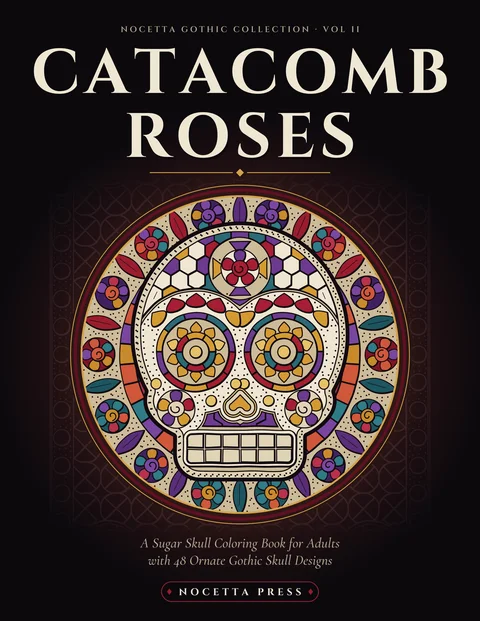
Skullplate's second book, Catacomb Roses, opens with a Memento Mori section of skulls adorned with hourglasses, candles, crowns and keys, followed by night creatures, roses and cathedral shadows. It's coming soon to Amazon. Our first book, Vesper Glass, is gothic rose windows and is available now as a $5.99 printable, and there's a free five-page sampler if you'd like to try a page tonight.
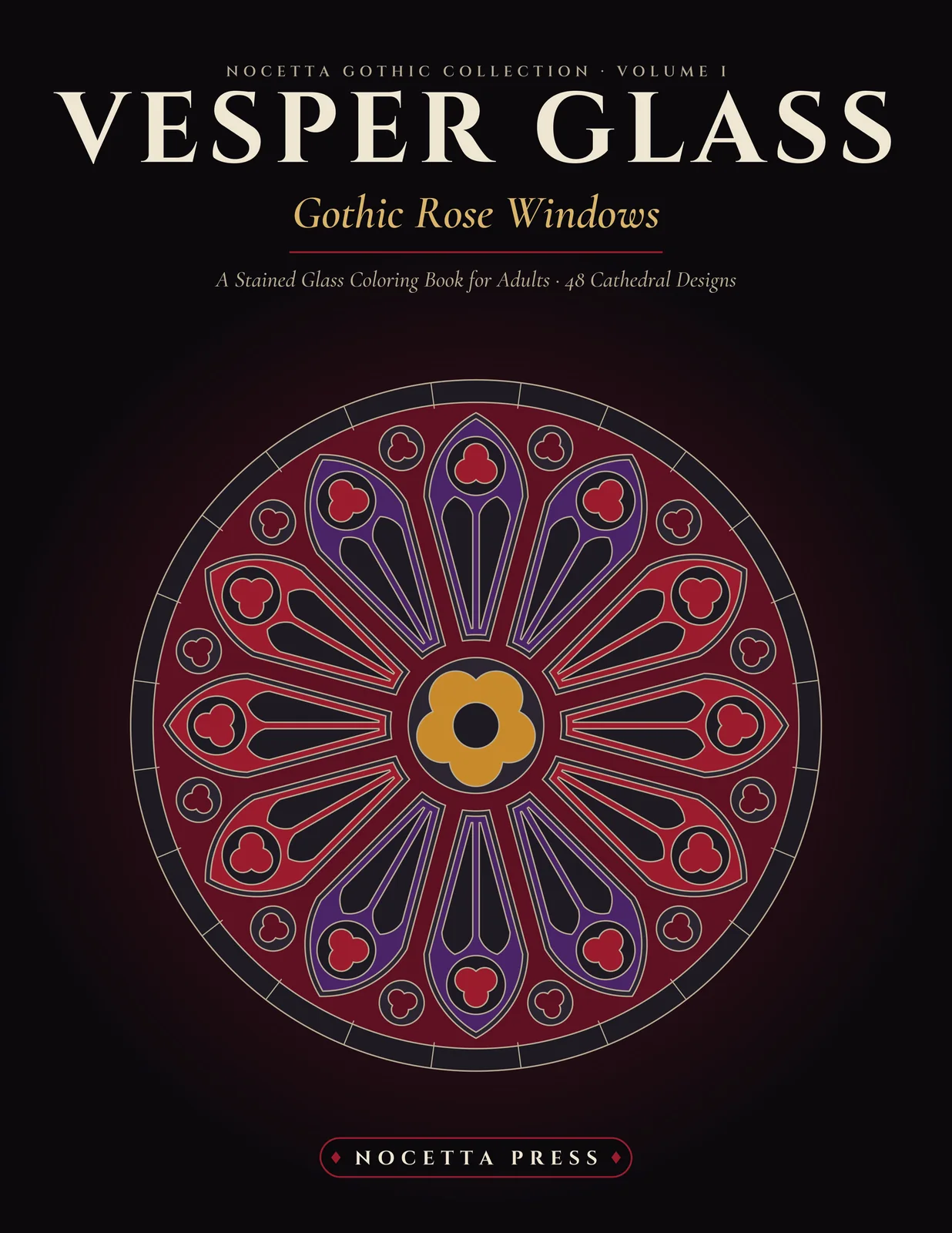
Vesper Glass: Gothic Rose Windows
48 cathedral window designs. $5.99 printable now; paperback coming soon to Amazon.
See the book