How to color sugar skulls
To color a sugar skull, start by choosing whether you want a bright, traditional look or a darker, gothic one, then pick four or five colors and repeat them symmetrically on both sides of the face. Color the large shapes first, such as the eye sockets, the forehead motif and the flowers around the eyes, and save small dots, scallops and highlights for last. That order keeps the page balanced and stops the fine detail from turning busy. Before the technique, it's worth knowing what these skulls mean, because they come from a living tradition.
What do sugar skulls mean in Día de Muertos?
Día de los Muertos, the Day of the Dead, is a Mexican holiday on November 1 and 2 when families remember and honor relatives who have died. The Smithsonian American Art Museum describes families visiting graves and building ofrendas, home altars covered with photographs, candles, sweets and favorite foods for the returning spirits (SAAM). UNESCO recognizes the indigenous festivity dedicated to the dead as part of humanity's intangible cultural heritage (UNESCO).
Calaveras de azúcar, the molded sugar skulls, sit on those altars. An artisan quoted by Smithsonian Magazine explains that the skulls represent the people who have passed and are receiving offerings, and that "the sugar symbolizes the sweetness of life" (Smithsonian Magazine). The Smithsonian Institution notes that the skulls are decorated brightly because they're a whimsical reminder of the cycle of life, not a morbid symbol. Many carry the name of the person they honor written across the forehead.
The elegant skeleton lady you often see beside them, La Calavera Catrina, began as satire. The printmaker José Guadalupe Posada drew her in the early twentieth century to mock Mexicans who copied European upper-class fashion (Smithsonian Folklife), and the image grew into one of the holiday's best-known figures.
How do you plan your colors?
Sugar skulls are built on symmetry, so your palette should be too. Pick one color for each matching pair of shapes, like both eye sockets or both cheek flowers, and keep it consistent. A symmetrical page looks finished and deliberate even if your coloring wobbles a bit.
The traditional look is vivid. Marigold orange is the flower of the season, so it belongs here, along with hot pink, turquoise, lime, violet and yellow on a white or pale skull. Four or five strong colors are usually enough. More than that and the page starts to look like confetti.
A darker, gothic version works just as well and suits Skullplate's style. Keep the skull ivory or pale gray and pick a deep palette for the decoration, such as crimson, plum, teal and old gold. Black backgrounds make the bone glow.
What order should you color in?
Big shapes first. The eye sockets are the strongest feature on any skull, so color them early. Deep colors or black inside the sockets, with a flower or a spiral motif on top, give the face its character. Next comes the forehead design, often a large flower, heart, cross or web, and then the nose, which is usually an upside-down heart or spade.
After that, work outward to the cheek and chin patterns and the petals around the eyes. Save the smallest details for last: the dots, scallops and little lines that echo the icing on real sugar skulls. White gel pen dots over finished color look especially like icing.
Leave the skull itself until near the end if you want to shade it. A pale base with soft gray or warm beige under the cheekbones, around the sockets and along the jaw makes it look three-dimensional without dulling the decoration.
How do you color a skull with alcohol markers?
Alcohol markers give smooth, saturated color, which suits sugar skulls well. Work from light to dark, lay down each color in small circles while the ink is wet and let it dry before adding a darker shade on top. For shading the skull, a pale gray and a warm gray applied in two layers are usually enough.
Use single-sided pages or slip a sheet of scrap paper behind the page, since alcohol ink bleeds through most paper. Gel pens and paint pens go on last, once everything is dry.
Where can you find sugar skull pages for adults?
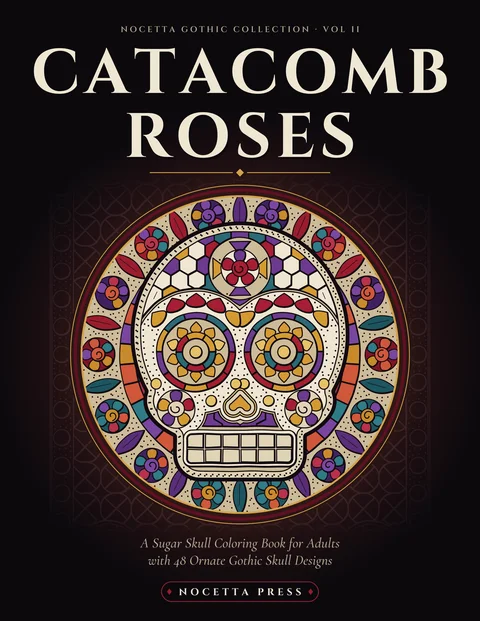
Skullplate's second book, Catacomb Roses, is a sugar-skull coloring book with 48 original designs in four parts: Memento Mori (skulls with hourglasses, candles, crowns and keys), Night Creatures (ravens, serpents, moths and bats), Garden of Bones (roses, blooms and vines) and Cathedral Shadows (gothic arches, lanterns and stained glass). It's printed single-sided on 8.5 × 11 in pages and is coming soon to Amazon. The designs are made with respect for the tradition they come from.
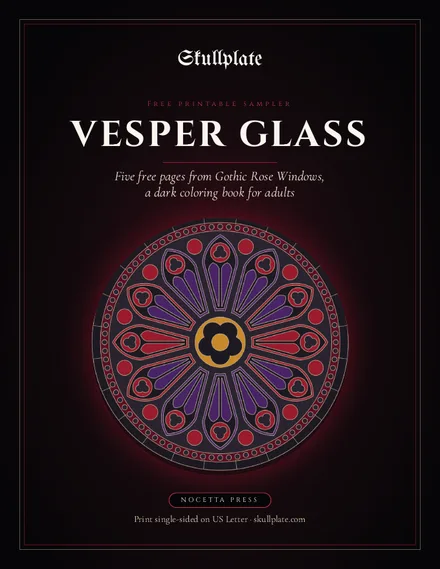
While you wait, the free Vesper Glass sampler has five printable gothic rose-window pages, and our guide to memento mori and its symbols covers the European side of skull art.
Questions people ask
What colors are traditional for sugar skulls?
Bright colors on a white skull are the classic look, especially marigold orange, pink, turquoise, purple and yellow. There's no fixed rule, and darker palettes are popular too.
What does a sugar skull represent?
On Día de Muertos altars, sugar skulls represent loved ones who have died and are being remembered. They're colorful because the holiday celebrates life and memory.
What's the best way to make sugar skull dots look like icing?
Add white gel pen dots on top of dry color at the very end. A slightly raised paint pen works too.
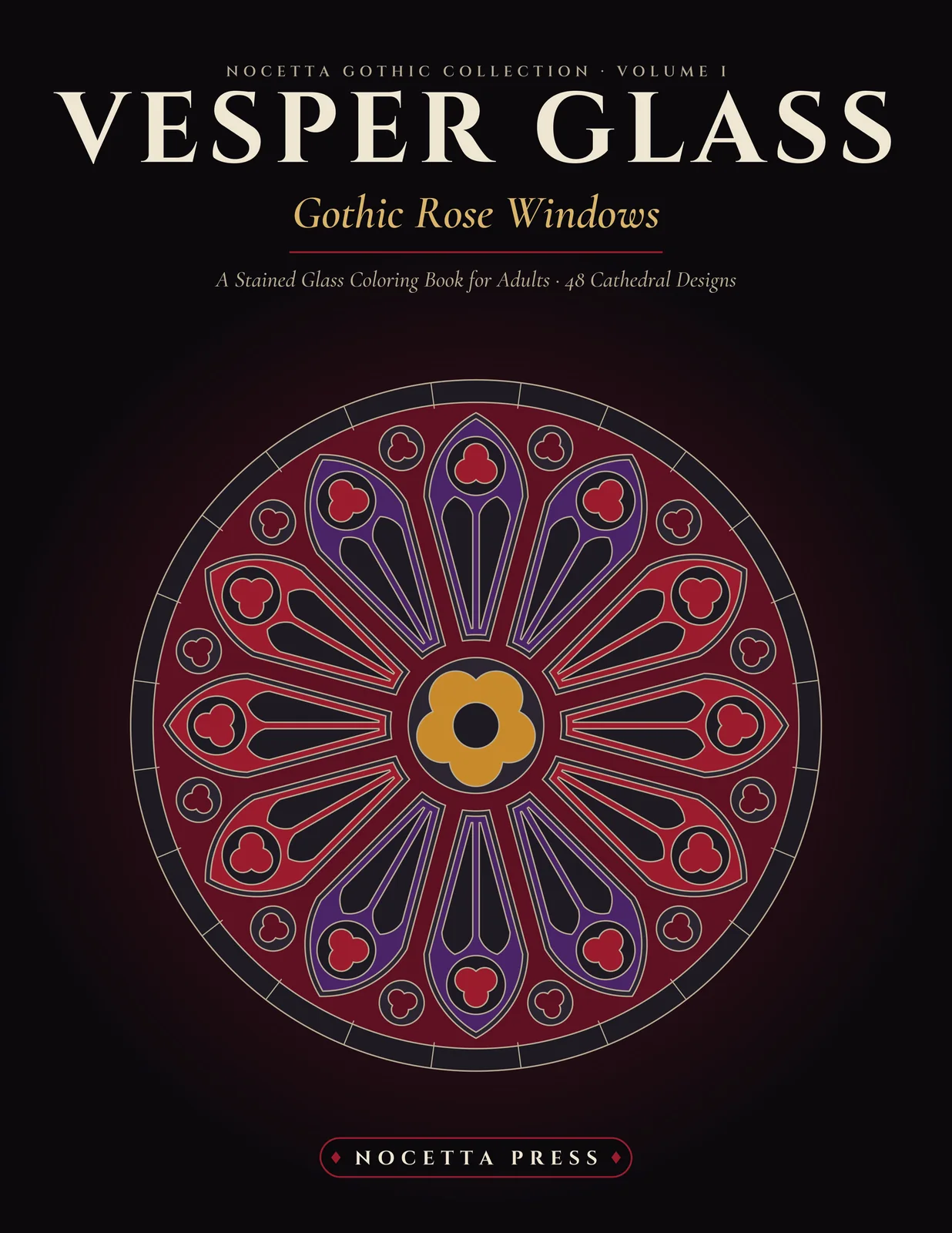
Vesper Glass: Gothic Rose Windows
48 cathedral window designs. $5.99 printable now; paperback coming soon to Amazon.
See the book